Accenture and TrueChoice.AI: Powering Chemicals & Materials Companies' Growth Through Real-Time Preference Analytics and AI
Accenture, powered by TrueChoice.AI, transforms real-time buyer intelligence into measurable revenue growth, margin expansion, and cost reduction. Designed for rapid deployment, the platform optimizes chemical supply chains, enhances customer experience, and reduces workforce costs — without long transformation cycles.


Our Joint Solution Proven in the Chemicals & Materials Industry
Slower demand recovery, margin pressure, and rising service costs are forcing chemical companies to make faster commercial decisions. Accenture brings global scale and deep industry expertise, and, together with TrueChoice.AI’s real-time preference intelligence, turns customer and employee signals into decisions companies can act on immediately.
Industry-agnostic, chemicals-industry proven
Track record across chemicals, industrials, life sciences, and financial services.
Insight to Action — End-to-End
Preference analytics IP embedded directly into your CRM, pricing engine, SCM, HRIS, and eCommerce stack. Accenture deploys and operates at scale.
One platform, many applications
Each solution area integrates TrueChoice.AI’s real-time preference analytics with Accenture's deep chemicals industry expertise — delivering rapidly actionable insights and accelerated speed-to-value.
Efficient Growth
TrueChoice.AI quantifies what your customers actually value and where they're willing to pay more. Combined with Accenture's go-to-market and pricing expertise, this turns into fact-based offer, channel, and pricing decisions that unlock cost-efficient growth without margin erosion.
Commercial Excellence
We measure the trade-offs your buyers make across price, product, service, and supply chain — then operationalize that intelligence into your sales process, channel strategy, and pricing engine.
Sales Compensation & Performance
We measure what truly motivates each salesperson, then redesign compensation plans and incentive structures to align seller behavior with your commercial objectives — embedded directly into your CRM and sales ops tooling.
AI-Powered Sales & Customer Experience
TrueChoice.AI plugs preference signal directly into CRM and CX tooling — Salesforce, Microsoft, SAP — so sellers can personalize pitches, prioritize pipeline, and tailor proposals to each buyer's value-drivers in real-time. Accenture deploys, integrates, and operates the model at scale.
Supply Chain & Service-Level Optimization
We pinpoint what customers actually value across service, supply chain, lead times, and product quality — then realign your investments accordingly, delivering significant cost reduction with no drop in satisfaction or share-of-wallet.
HR Cost Optimization
We measure employee preferences across compensation, benefits, flexibility, career, and culture — then redesign reward, recognition, and workforce structures to deliver more value to the people you most want to retain, at lower total cost.
Case Studies.
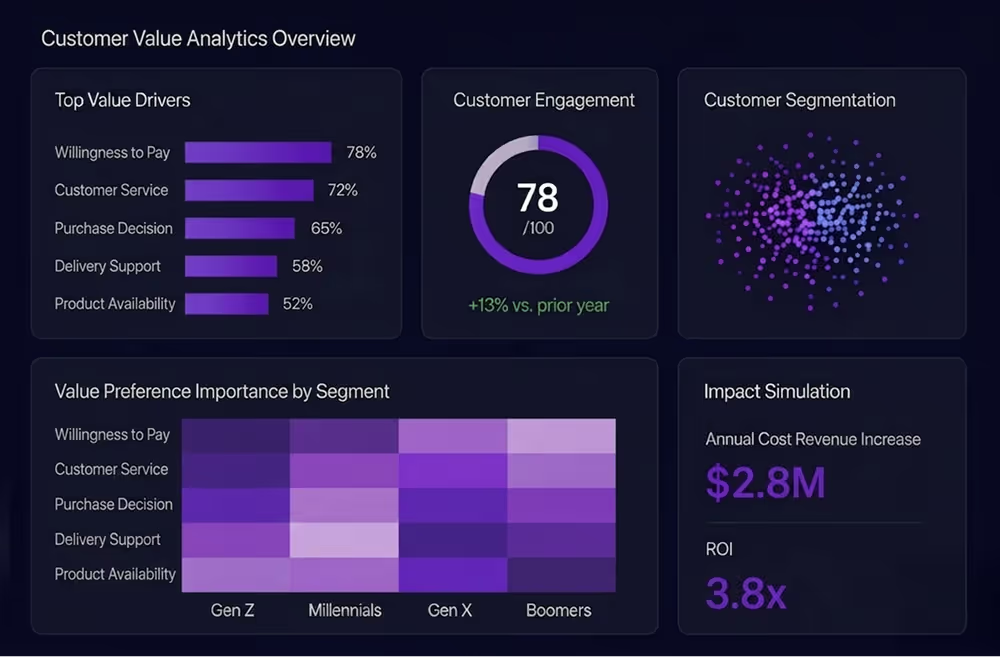
Cutting cost-to-serve without losing customers
A leading specialty chemicals manufacturer was over-investing in service levels its B2B customers didn't value, while under-delivering on the factors that drove retention. Cost-to-serve was rising, customer satisfaction remained flat, and leadership needed a fact-based way to realign priorities.
THE CHALLENGE
The client needed to stop over-investing in service levels its B2B customers didn’t value and realign priorities based on actual needs, to reduce rising cost-to-serve while maintaining customer satisfaction.
OUR APPROACH
- Quantified buyer value-drivers and cost levers by segment and geography.
- Identified quick-win realignments of supply-chain and service-level commitments.
- Aggregated CRM and feedback data into 1:1 customer preference profiles.
- Built a longer-term roadmap for supply-chain and offer redesign.
Smarter rewards. lower costs: A chemicals provider success story
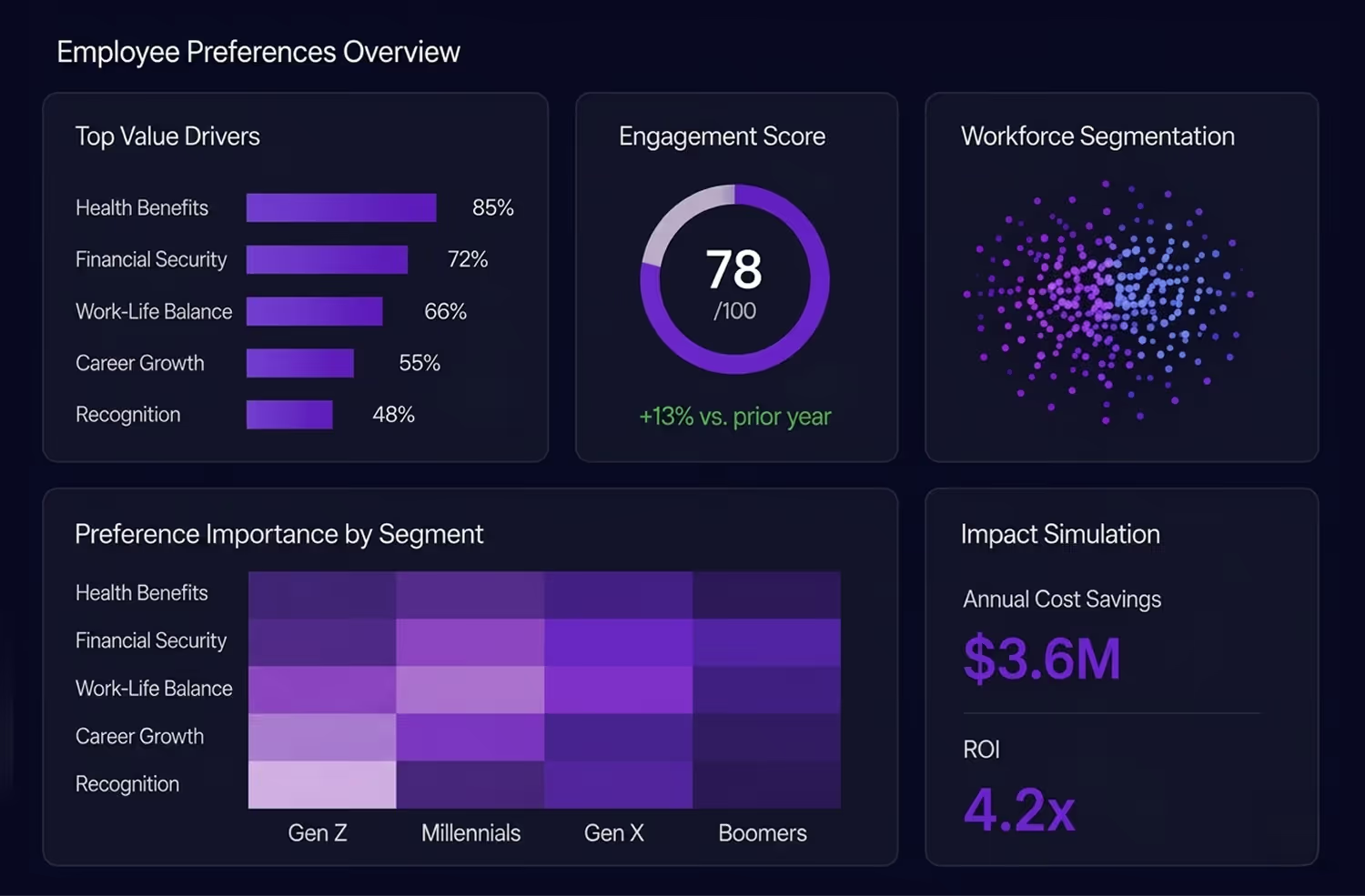
How a leading US healthcare provider used real-time preference analytics to optimize rewards and benefits - reducing HR costs while improving employee experience and retention
THE CHALLENGE
The client needed to reduce HR costs across multiple workforce segments while maintaining engagement, retention, and employee satisfaction.
OUR APPROACH
- Captured real-time employee preferences across rewards, benefits, and experience
- Quantified the drivers of engagement, retention, and perceived employee value
- Redesigned rewards and benefits aligned to what employees value most
- Built workforce personas to improve communication and decision-making
Accenture's TrueChoice.AI — Conversational Intelligence for Chemicals & Materials Industry
Accenture’s TrueChoice.AI transforms complex buyer and employee preference data into clear, actionable decisions — delivered through natural conversation, not static reports or complex dashboards.
How It Learns
Accenture's TrueChoice.AI integrates with the latest foundation models,optimized for data analytics, utilizing proprietary, structured TrueChoicepreference data — generating high-quality signals designed for decisionintelligence and AI reasoning.
How It Reasons
Combines TrueChoice.AI analytical outputs with AI-driven reasoning to deliver explainable, reliableguidance for real decisions - not just predictions.
How Users Engage
Users ask business questions in natural language and receive synthesized, decision-oriented responses — not just dashboards or static charts.
Why Accenture + TrueChoice.AI
FROM DASHBOARD TO DIALOGUE
Users ask plain-language questions — "Which intermediates should we reprice this quarter?" "Where am I over-serving accounts?" — and get ranked, explainable answers grounded inthe WTP model and CRM data.
STICKY DATA MOAT THAT COMPOUNDS
Every dialogue, every interaction makes the engine smarter and the data harder to replicate. This is not a model trained on thepublic internet — it is trained on proprietary 1:1 buyer-value evidence.
SERVICE-PRICED, NOT SEAT-PRICED
TrueChoice.AI is sold as outcomes (margin, retention, employee), not licenses.

Accenture's TrueChoice.AI
Sales & Service Optimization Use Case
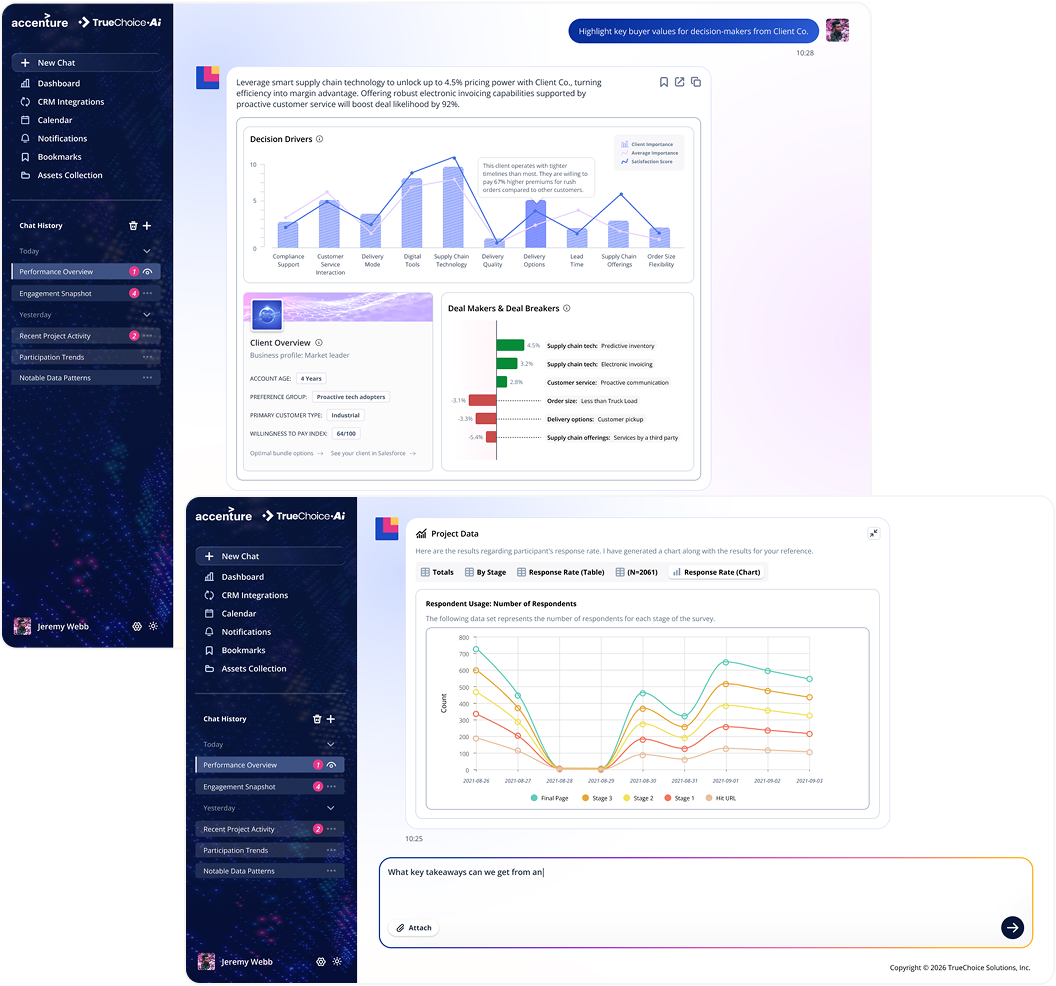
Decodes exactly what each buyer values — from supply chain technology to delivery flexibility — and maps the decision drivers that shape every purchasing choice.
Quantifies willingness-to-pay at the individual level — so your team knows precisely what premium each client will pay for specific features and offerings.
Exposes your real deal makers and deal breakers — by segment, account, and product — so every sales conversation is backed by evidence.
Identifies exactly where you're over-serving — so you can cut costs without risking customer relationships.
Identifies your highest-value prospects and exactly how to reach them — with messaging precision that turns the right conversations into closed deals.
Optimizes service levels by what drives customer loyalty — protecting margin without sacrificing satisfaction.
Reveals untapped revenue hiding in your existing customer base — identifying upsell and cross-sell moments before your competitors do.
Built for the commercial leader who needs to grow revenue, reduce cost-to-serve, and finally know which levers actually move the needle.
HR Cost Optimization Use Case
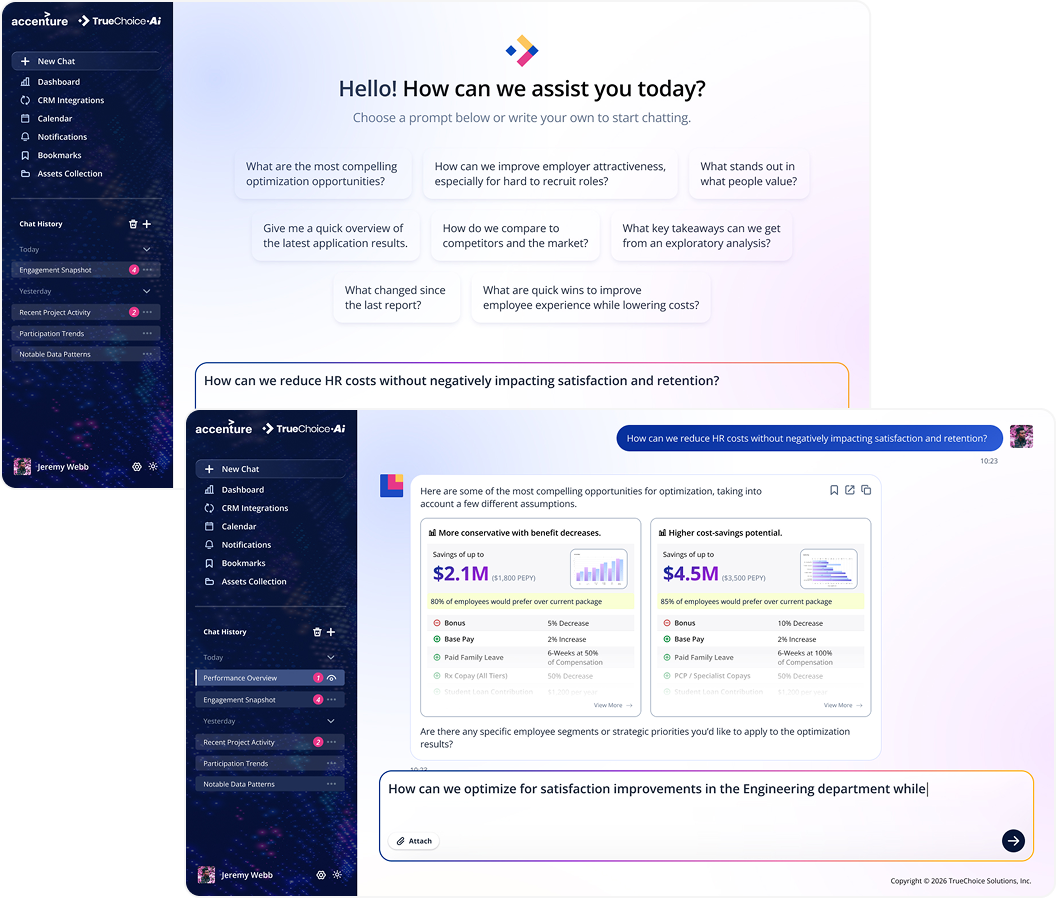
Connects the dots across HR spend, engagement, retention, and performance — surfacing what's driving cost and what's driving value.
Quantifies exactly what your employees value — by role, geography, and tenure — so you stop spending on benefits that don't move the needle.
Models every optimization scenario so you can cut costs confidently, without guessing what retention impact to expect.
Translates complex decisions into plain language — strategic and operational risks, explained in seconds, not weeks.
Identifies which HR programs deliver the highest ROI — and which ones are quietly draining budget.
Pinpoints churn risk before it happens — flagging which employee segments are most at risk when you reduce or reallocate spend.
Makes you a more attractive employer at lower cost — aligning your offer to what top talent actually values.
Thought Leadership

Your Product Portfolio is lying to you. Here's how to make it tell the truth.
Most B2B companies manage their product portfolios the same way they have for decades: spreadsheets full of margins, cost-plus pricing models, indexing off public benchmarks instead of measured value, conversations that stop at the procurement desk rather than reaching the people who actually use what's being bought, and gut instinct about which products "feel" like winners. But in a world of tariff shifts, volatile input costs, and increasingly sophisticated buyers, that approach is quietly bleeding value — and most leadership teams don't even realize it.
We have spent years working on this problem, and the uncomfortable truth is this: cost and margin data alone cannot tell you which products are actually worth investing in. They tell you what things cost. They don't tell you what customers value. That gap — between what you charge and what your customer is willing to pay — is where the real money lives.
The hidden cost crisis in Resources
Why Chemicals Companies Are Rethinking How They Spend on Their People
The Chemicals and Resources sector is no stranger to cost pressure. Commodity cycles, capital-intensive operations, and razor-thin margins have trained leaders to scrutinize every line of expenditure. Yet one of the largest cost centers in any Resources company remains stubbornly opaque: the workforce.
HR and total rewards budgets in the sector routinely represent 40 to 60 percent of controllable operating costs. And while companies have invested heavily in optimizing supply chains, equipment uptime, and energy efficiency, most are still designing employee rewards and benefits packages with the same blunt tools they relied on a decade ago: benchmarking surveys, broad demographic assumptions, and gut instinct.
The result? Billions spent on offerings employees don't actually value — and a widening gap between what companies pay and the engagement, retention, and performance they get in return. In an era when AI-driven analytics are transforming every other part of the business, the workforce equation is overdue for the same treatment.

Led by Experienced reinventors